
Page Options
You are here : Magazine Articles
  Minimize
20

Turbo Tech: Generating Compressor and Turbine Maps

By Khiem Dinh


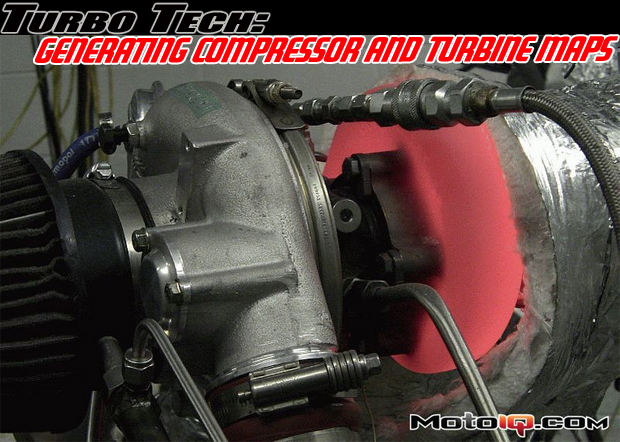
Compressor and turbine maps are the spec sheets for a turbocharger.  They characterize the performance of a turbocharger allowing engineers to properly choose the correct combination of wheels and housings for their particular application.  Compressor and turbine maps for a turbocharger are the equivalent of a dyno sheet for an engine; the maps and dyno sheet provide performance information over a wide range of operating conditions.  In the same way engines need specialized equipment to get a dyno sheet, turbochargers also need specialized equipment to generate compressor and turbine maps. 

Typically, compressor and turbine maps for turbochargers are generated by running a turbo on a properly instrumented gas stand in a test cell.  A gas stand typically burns natural gas to drive the turbocharger.  The test cell, with the gas stand inside it, provides a controlled and consistent environment for repeatable testing.  It would be possible to make a compressor dyno that would only test the compressor side relatively easily but the turbine side can be much more complicated. Also, the turbine map changes drastically depending on the compressor wheel, bearing system, and turbine housing used for testing.  The compressor housing itself can also have a minor affect on the turbine map.    Therefore, it's the match of a compressor and turbine that determines a turbocharger's performance, so it's convenient and logical to test them together in the form of a turbocharger.  

Generating the compressor and turbine maps requires accurate and precise measurements of mass flow rates, temperatures, pressures and turbocharger shaft speed.  The maps are generally created by running the turbocharger at a constant speed and varying the pressure ratio on the compressor side.  This can be done by restricting the flow on the compressor outlet.  Every speed line on a compressor map for a turbocharger has a matching line on the turbine map.


Here is a compressor map from Garrett.  Notice each of the individual speed lines on the map.  On a Garrett map, the left most point of the line is determined by compressor surge and the right most point by 60% efficiency.  Each speed line is created by taking data at multiple points and connecting the dots.  The gas stand must maintain the turbocharger at each point for a certain amount of dwell time in order for all the readings to stabilize.  If the gas stand were to just sweep across each speed line, the readings would not accurately reflect the actual efficiency due to the time lag for components to reach stabilized temperatures.  It's like boiling water on the stove; it takes the water a while to reach boiling temperature.


Here is a compressor map from Borg Warner.  The Borg Warner map is a little different in that they plot out the speed lines until the pressure ratio nearly goes down to 1.0.


Plotting compressor speed lines versus pressure ratio and mass flow rate is relatively easy as measuring pressure and flow rates is simple to do with a high level of precision and accuracy.  For a compressor, it's even relatively easy to calculate efficiency.  The basic definition of efficiency is how much you get out of something versus what you put in.  I seem to only have about a 99% sock washing efficiency as I seem to only get back 99 socks out of every 100 I wash.  For a compressor, efficiency is defined as compressor power out divided by power put into the compressor; if you recall, I covered this in Compressor Efficiency and More.  In short, to calculate compressor efficiency, you only need to know temperatures and pressures if you make an assumption of a constant specific heat value; this is a reasonable assumption when the temperature range is only a couple hundred degrees Celsius. 

 

Pages: 1 of 4 Next Page
Posted in: Magazine, Tech

Comments

Der Bruce
# Der Bruce
Tuesday, December 20, 2011 10:39 AM
I think my brain officially overheated due to the inefficiencies of both my compressor and turbine side of knowledgeable digestion and regurgitation for use :p
SkullWorks
# SkullWorks
Tuesday, December 20, 2011 11:27 AM
too many words, dont post so much info for consumption before the coffee hour

wow more than I needed to know about turbos

Do you have access to a test cell I'd love to see what my 2868HPA compressor map looks like
Mr. T
# Mr. T
Tuesday, December 20, 2011 11:45 AM
WOOSH!!! that is the sound of this article flying past the top of my head
silverbullet
# silverbullet
Tuesday, December 20, 2011 12:10 PM
nice revisit of thermal applications!
sr20freak
# sr20freak
Tuesday, December 20, 2011 1:22 PM
uhhhh, huh huh, huh huh, uhhhhhh Beavis, what the hell did he just say?? I don't know butthead, but he did say Pimpin' aint easy. uhhhhh, what a assmuncher. But I still think turbos are cool. yeah, yeah, cool.

......nice write up Khiem, if I even don't understand Engineerese.
eccentric
# eccentric
Tuesday, December 20, 2011 2:01 PM
"You down with entropy? Yeah, you know me!" MC Hawking –

Thanks for the article, it cleared some stuff up!
Def
# Def
Tuesday, December 20, 2011 4:30 PM
What sort of temperature measuring equipment are you going to be using? The amplification part of thermocouple measurement is fairly accurate (on the order of that 0.1K guesstimate), but the actual TC calibration is typically +/- 2.5 deg F for commercial grade TC, and +/- 1.5 deg F for lab grade TC. You can get more accurate than this, but it gets ridiculously expensive in a hurry.

Accurate pressure measurement is fairly easy, but the problem you'll likely run into is dealing with transient pressure conditions accurately with anything remotely affordable. Typically once you go over 1 Hz in the digital world you're looking at $$$. Note, you have to measure at least 5x to get resolution of what's happening in your desired time frame as a general rule of thumb. So you need a 5 Hz sensor to have an idea of what's going on if your pressure is cycling over a 1 Hz period (which is really slow). Typically anything with quick transients calls for 1 kHz sensors. These cost more than your house with high accuracy!

The good news is that sensor heat concerns are not an issue at all. Just use some swagelok (or Parkerlok) 316SS fittings with a 1/8" NPT fitting on the turbo side, then run a length of maybe 12" stainless tube out to the pressure sensor. Done. Nothing will leak when put together properly, and it'll introduce no measurement accuracy issues as long as you're 90 degrees +/- 5 to a streamline (i.e. drill perpendicular to the casting and you'll be fine).

I've done instrumented testing just to see if you'd get a "spring effect" from the column of air and there is none. The speed of sound is just so fast compared to your usual response time on a semi-steady state test that it's not an issue. You can't even see the noise with a nice 25 Hz sensor.
DaGou
# DaGou
Tuesday, December 20, 2011 8:09 PM
Where do the socks go? But seriously the best part of is not your understanding but to be confident that Mr. D has total of the subject. Ergo he probably already has selected the most perfectest Turbo for his and mine project S2000. And for the rest of you I am sure he has turbonic tidbits to help you out.
spdracerut
# spdracerut
Wednesday, December 21, 2011 10:05 PM
@Def, I don't know what the labs use and I haven't seen the raw test stand data from mapping the compressor and turbine wheels. I have recently gotten some data from an engine stand and the resolution on the temperature is 0.01C, and pressure resolution is 0.01 mbar, so 0.00001 bar.

On the gas stand for mapping, no issues with transients or pulsations as it's a constant gas flow. The data points along each speed line are taken during steady state conditions. I think they dwell at each point for roughly 8-10 minutes.

Post Comment

Only registered users may post comments.

          MotoIQ Proudly Presents Our Partners:


Copyright 2012 by MotoIQ.com
Privacy StatementTerms Of UseAdvertise