
Page Options
You are here : Magazine Articles
  Minimize
17

AQ Motorsports STI Getting the GTX Upgrade

By Khiem Dinh, photos by JC Meynet

Khiem Dinh is an engineer for Honeywell Turbo Technologies at the time of this writing.  All statements and opinions expressed by Khiem Dinh are solely those of Khiem Dinh and not reflective of Honeywell Turbo Technologies.

Heading into this year's racing season, JC Meynet needed more power than his trusty two year old Garrett GT3582 could provide.  What was the answer?  A GTX3582 of course!  There are a few reasons why the GTX upgrade made a lot of sense, but most importantly it had to deliver on the power.  To find out the reasons, keep on reading.

Here's the GTX3582 nestled in the engine bay.  Notice the heat shielding to keep cooler air fed to the turbo.

A wise racing man once said, "To finish first, first you must finish."  JC has been beating on this setup for two years now and worked out the kinks.  After testing some fabricated exhaust manifolds, he reverted back to the stock cast exhaust manifolds because the other ones cracked.  In the two years of pushing the GT3582 to the limit, and beyond actually, it still spins perfectly just like the day it went on.  It has proved durable even though no blow off valve was used!  The thrust bearing in a journal bearing turbo would be destroyed in short order with no BOV, but the ball bearing cartridge is durable enough to take the abuse.  It's still not recommended to not use a BOV though!


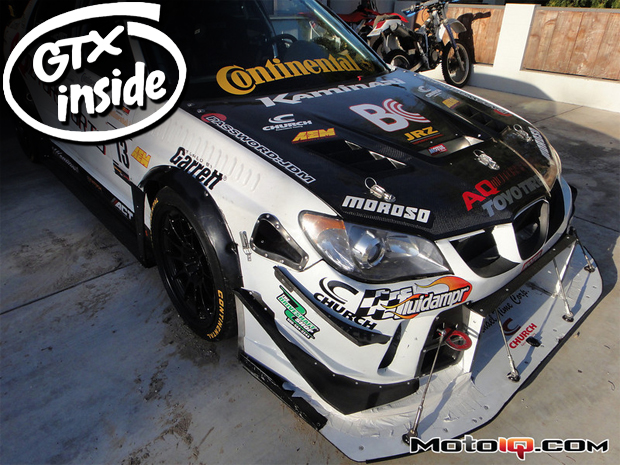
Check out the NACA duct next to the head light to feed cool air to the intake.  JC and the AQ Motorsports boys know that cooler is better.  As they would say, it's hella functional!  Check out our article on compressor efficiency because thermo doesn't lie.

As some other smart person once said, “Don’t mess with a good thing.”  This made the GTX3582 a logical upgrade from a reliability standpoint.  The other critical reason was being a drop-in replacement.  Why was this so important?  JC and the AQ Motorsports team had less than a week to get the car ready before the Modified Tuner Shootout in Phoenix.  That left no time to do new manifolds, downpipe, intake, IC piping, oil lines, or water lines.  Well, not if anyone wanted to get any sleep.  Plus, it’s way cheaper not to do those other things anyways. 

So on to the raison d'etre of the GTX, more power in the same package.  The first comparison is both turbos at 30psi.  The next set of graphs has the turbos in max kill mode.  The tuning and dyno plots are courtesy of Shawn Church of Church Automotive.
Pages: 1 of 2 Next Page

Comments

Talkurt
# Talkurt
Monday, April 18, 2011 5:04 AM
Title teasing. I thought/hoped this was a post about a 323 GTX :o
Tony
# Tony
Monday, April 18, 2011 5:52 AM
Good article on the new GTX turbochargers from garrett!

Good to see Garrett bringing something fresh to the (after)market, as with new BW EFR turbos are making a splash right now too.

I run a GT3582 on the miata, and this GTX seems like a worthy upgrade. Depends entirely on whether or not the tial turbine housing will still be compatible with the turbo though. Not going back to a T3 flange'd setup.
rawkus
# rawkus
Monday, April 18, 2011 7:48 AM
From my understanding the turbine and CHRA are the same as before. The GTX series just has a new compressor wheel (and perhaps matching housing, but I'm not sure about that).
jamal
# jamal
Monday, April 18, 2011 1:11 PM
It's funny how E85 lets you run right off the edge of the compressor map.
mikemiessler
# mikemiessler
Monday, April 18, 2011 3:58 PM
Looking at the compressor maps do you have any idea as to why they're pushing them out to the edges of the efficiency circle? granted the airflow is a little more efficient but not by much. Just thinking it wasn't looking as impressive as a car that could be doing more with a better turbo selection (i.e. turbo looks like its too small for the cfms). Cool car anyways. Gotta love racecars!
jamal
# jamal
Monday, April 18, 2011 4:41 PM
well we run it out there because the E85 lets us. Going to a larger turbo to make the same power would mean slower spool and a shorter powerband. That's also the "super kill mode as much boost as it makes" map, which actually peaks at 38psi. During the modified shootout we ran 38 on the dyno and drag strip, 30psi at the auto-x, and 35 on the time attack.
spdracerut
# spdracerut
Monday, April 18, 2011 6:25 PM
@mikmiessler, as jamal as already commented, running a larger turbo would introduce too much lag reducing the area under the power curve. For reference, the Apollo Performance STI went from a GT4088 on a twin-scroll setup to a GTX3582 and gained about 800rpm of spoolup.

30psi on this particular setup is still probably ~70% compressor efficiency. 35psi ~68% efficiency. 38psi is probably ~60%. A sacrifice of a little top-end is worth it for the gain in mid-range.
junior
# junior
Tuesday, April 19, 2011 10:10 AM
@spdracerut

Do you know how much power Apollo Performance lost going from the 4088 to the GTX3582? If just going by the compressor maps, the GTX35R can flow as much as a 4088.....will it actually be able to flow that much with its smaller turbine wheel is what I am curious about. If you know what the difference in power was on that car after the switch in turbo's please share as I currently have a 40/88R on one of my cars and have thought of switching to the GTX35R.
mikemiessler
# mikemiessler
Tuesday, April 19, 2011 10:18 AM
Fair enough Jamal. Quicker spool reasoning makes sense especially for the autox application. Di you guys find anything disappointing about the turbo? Would you have changed anything looking back with 20/20 hindsight?
jamal
# jamal
Tuesday, April 19, 2011 11:46 AM
No this turbo was exactly what we needed: a direct drop in replacement that made more power without sacrificing spool. Frankly with these results I don't see the point of the fancy twin scroll setups - it just seems like a lot of added cost, complexity, and weight without much benefit. Plus it's great to be able to do this with our off the shelf rotated up-pipe.

Anyway the car really doesn't need any more power and we're going to work a lot harder on analyzing data to go faster this year. We have a gps transmitter, brake pressure, and suspension position sensors in addition to the usual stuff, which we have not been using to the full advantage.
spdracerut
# spdracerut
Tuesday, April 19, 2011 11:54 AM
@junior, Apollo is only pushing low-mid-500hp range on their dyno. They are using Full-Race's divided manifold setup. With the GT4088 with 0.95 A/R divided, they were using 19psi. They are running 24psi with the GTX3582 with T4 flanged 1.06 A/R which allowed it to drop right in place of the GT4088. I want to say they are making ~20whp more with the GTX3582. So, there appears to be more exhaust back pressure with the GTX3582 which is to be fully expected with the smaller turbine wheel (5psi more boost, only ~20whp gain). But they are still able to making essentially the same power as the GT4088 with a lot better spoolup.
mxpop
# mxpop
Tuesday, April 19, 2011 11:37 PM
FWIW from a driver's perspective, this car has never been better than it is right now in every way with this new setup. It even worked amazingly well in the AX event even though it was never conceived as an AX car. We AX'ed against some of the best in the business and exceeded our hopes and expectations (altho the rear diff was opening badly, new diff in the works.....)

Cant reveal details of Shootout event until Modified Magazine article comes out in a few months but will have detailed info at hat time.

Bottom line: GTX performed 100% as hoped and was a straight forward replacement for our prior GT turbo that was already a great performer :-)

Post Comment

Only registered users may post comments.

MotoIQ Proudly Presents Our Partners:


Copyright 2012 by MotoIQ.com
Privacy StatementTerms Of UseAdvertise