
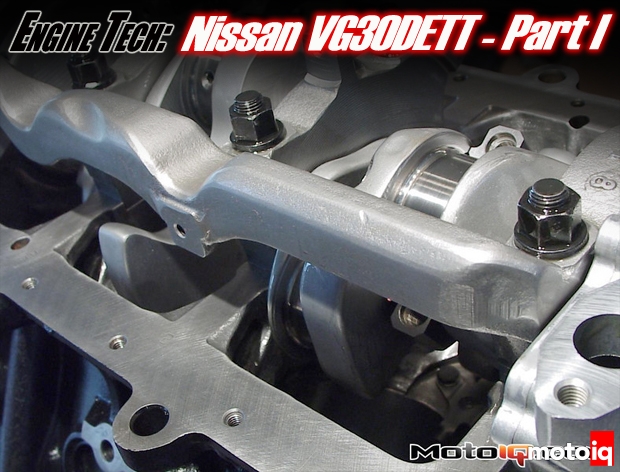

Engine Tech, Building the Nissan VG30DETT part 1
By Mike Kojima
Found in the 1990 to 1996 Nissan 300ZX twin turbos, the Nissan VG30DETT is a robust, sturdy engine right out of the box. The VG30DETT like many Japanese engines of the era is pretty stoutly overbuilt in stock form, making it an excellent candidate for wringing high power levels out of it.
In its time, the engine was a work of art, featuring aluminum heads with 2 quench pads per chamber, a 45 degree included angle pent roof combustion chamber and two overhead cams per cylinder bank. The combustion chamber was equipped with 4 free-flowing valves per cylinder. The ports were positioned for good flow with almost a straight shot to the combustion chamber. The intake cams featured a variable timing device which reduced valve overlap at idle, smoothing it, and at high rpm’s for better top-end breathing. The rigid iron block featured stout construction with a fully girdle supported main cap system which made for a super stiff and strong bottom end. The crank and rods are forged steel units from the factory. The pistons were oil cooled by sprayers located in the block, fed by a standard high volume oil pump. The engine’s specs read like a racing engine build sheet right from the factory. Race this engine did, the VG30DETT was the basis of the engine used to power Nissan’s all conquering GTP car which won many an IMSA title in the late 80’s and early 90’s.
All though the VG30DETT has been overshadowed by its younger bother the VQ family whose better cylinder heads and lighter construction make it a real powerhouse in the 350Z, 370Z and GT-R, the old dog VG30DETT can still hold its own and pull some impressive power number when modded. The VG30DETT is an exceptionally strong motor but we will have to do some in-depth rework of its internals to reliably make big power on a regular basis. Getting an already powerful engine to double its specific output is asking a lot, even from the most stout of stock units. Our goal is a difficult one, to obtain race car power with stock car reliability and reasonable, street useable driveabilty.
Enough talk, lets get to work in prepping the basic bits of our mighty motor.
The Block
Getting a good block is the basis of building a solid high performance motor. As we are planning a significant overbore to 89mm (stock is 87mm) to bring our displacement up to 3150cc from the stock 2960cc, it is important to verify that the block can handle such an overbore. Normally it is not advisable to bore the VG30DETT more than 0.020” or 0.50 mm oversize as the VG has relatively thin cylinder walls, however bigger bores are possible if the block is first checked out to make sure that there is enough iron to do it safely.
 |
| With our stock block, the water passage was completely blocked with casting flash and core shift. You could not see from end to end. This is why the VG is known to have the rear cylinders run hot and why the rear cylinders suffer detonation damage first. |
Clark Steppler of Jim Wolf Technology checked our block with an ultrasonic thickness gauge to make sure that our block had enough meat to support our big bore intentions. An ultrasonic tester uses reflected ultrasonic waves to measure the thickness of the cylinder walls. Clark measured the block in four places around the bore’s circumferences in four places up and down the blocks cylinder walls to get an overall picture of the cylinder wall thickness.
 |
| A view from the top shows the water passage blockage through one of the top freeze plug holes. |
After verifying that our block was thick enough to safely bore to 89mm, it was sent to Cryo Science to be cryogenically treated. Cryogenic treating is an extension of the heat treating process where the block is slowly cooled to near absolute zero (-320 F) with liquid nitrogen and allowed to cold soak. The metal parts are then brought up to about 360 degrees (to temper the metal) and slowly chilled again. This is repeated 3 times or more during a 72 hr or longer total cycle.
 |
| After porting there is a clear unobstructed view down the entire length of the main water passage. |
Cyro treating totally stress relieves the block and actually strengthens it by increasing the amount of hard crystalline martensite (a hard crystalline variant of iron ) carbide inclusions within the metal. It also rearranges the metal’s molecular structure into a better symmetrical crystal matrix with more complete molecular bonds which further helps strength. These micro changes also increase abrasion resistance and increase the lubricity of sliding surfaces, reducing friction. You can expect much longer wear of the cylinder bores as well as improved dimensional stability under all conditions. The improved dimensional stability improves head gasket and piston ring seal. Cryo treated blocks can make up to 6% more power just due to better ring sealing and less internal friction alone.
 |
| After porting the top view is much clearer as well. |
In many ferrous metal applications cryo treating can increase wear resistance by over 800%, fatigue strength by over 100% and tensile strength by up to 25%. The typical increase of wear resistance in cast iron like our block is 100%. As these improved attributes are all desirable things to increase in a high performance motor we are glad to to take the time to do it. The price of cryo treating is relatively reasonable, yielding a good return for the money. Although cryo treating is virtually unheard of in street car engine building it is one of the secret tricks that many top engine builders use to gain improved hp and reliability.
 |
| After the water passage was ported out the water jackets were filled with Devcon steel filled epoxy up to the level of the water passage. This was about 1/2 of the water jacket height. This helps support the cylinder walls and stiffen the block without affecting cooling. You can see the Devcon through the top freeze plug. |
The next step in building our engine was porting our main water passage. VG30’s have a lot of core shift and casting flash blocking the main watter passage in the center of the block, so much so that you usually cannot see down the passage from end to end. Because of this the rear cylinders tend to run hot and detonate. Mike Smith;JWT’s ace fabricator cleaned up the water passage with long shanked carbide cutters and cartridge rolls. Now the water flow is unimpeded down the length of the engine, at least 50% better. Our engine will run much cooler due to it!
Mike then polished the inside of the block to reduce windage losses, remove stress risers, remove entrapped casting sand and to speed oil return. It is amazing to see how much actual sand is stuck into the surface of a cast iron part, ready to break off and wreck havoc with your bearings. Much of the sand is not apparent to visual inspection but is lurking there ready to make your life miserable. We were shocked to see the handful of sand particles that were present in the polishing debris when Mike was finished.
 |
| Our nice smooth cylinder walls will allow our rings to seat quickly. Modern rings require smoother finishes than those traditionally used. |
Since we will be pumping nearly twice the amount of power that the engine is rated for in stock condition, we did a few extra measures to help ensure the engine’s bulletproofness. JWT filled the block’s water jackets 50% of the way up with a tough metal filled epoxy (similar to the redneck fix-it-all, JB Weld) to help reinforce and stiffen the block. This block filling can reduce cylinder wall and block flex which can improve ring seal and bearing life. JWT used a metal filled epoxy because the metal fill gives the plastic epoxy resin a coefficient of expansion very close to that of the iron block. This prevents the epoxy from cracking or separating from the block’s interior. Filling the block like this does not affect cooling in any way. Nissans newer VQ35DE engine has much shorter water jackets than our filled ones stock from the factory. Filling the block is a common trick that was used by NASCAR circle track engine builders to get more strength out of their underbuilt, flexy Domestic V-8 engines before the advent of factory “Super Duty” racing blocks.
 |
| For iron blocks it is a good idea to polish the block’s interior, this removes embedded casting sand before it can break loose and circulate inside the engine and helps speed oil return. We were amazed at the amount of sand that was removed when this step was done. |
After filling the block, it was checked dimensionally for proper main bore and deck alignment to see if the block required any special secondary operations like align boring or deck milling. Nissan blocks are very strong and almost never need these operations unlike domestic motors where these operations are almost mandatory with a performance rebuild. The block was bored with JWT’s torque plates. Torque plates are plates made of thick aluminum that are bolted to the block’s deck before machining. Torque plates simulate the stress and distortion to the block that bolting on the cylinder heads creates. By using torque plates the cylinder’s bores will be straight and round once the heads are bolted in place. JWT is the only company in this country to our knowledge that has Nissan Torque plates. This extra touch operation speeds break in of the engine and ensures good piston ring seal.
 |
| Our Nissan VG30DETT block prepped and ready to go. ARP main cap studs are much stronger than the stock bolts. |
Smith also polished the main cap/main cap girdle assembly to remove all stress risers in the rough casting. ARP high strength studs were screwed into the block and locked in place with green Loctite stud retaining compound. Studs are stronger than bolts because they place the assembled parts in compression instead of tension. The high grade ARP studs can also be torqued to a higher value, helping to ensure that the main caps will not walk around under extreme loading. The main caps were torqued down before boring as main cap stress can also slightly distort the bore.
After the studs were tightened down and the Loctite cured, Smith align honed the block. This helps ensure that the main caps are straight and helps precisely control the bearing clearances. Align honing is grinding off a few thousandths off of the bottom of the main caps, then running a stone hone through the main saddles to restore roundness to the bearing bores. This ensures that the crank will sit in its caps absolutely straight. This process is done at the factory, but as a block is used, it is common for everything to shift a bit as the block is seasoned through use. Seasoning is one reason why a used block can often produce more power than a brand new one. The use the motor received before it came into our hands and the cryogenic treating assures that our block is seasoned and will be dimensionally stable.
After the align honing, Smith then removed all oil passage plugs, replacing them with allen headed screw in plugs. These plugs ensure that a failure will never occur due to a plug popping out and allow a thorough cleaning of the blocks oil passages. When the stock plugs were drilled out, Smith then used rifle brushes to thoroughly clean out every oil passage in the block. If you have built motors before, this is a very important but often skipped step in engine preparation. As many of the oil passages end in blind holes, it is amazing how much gunk and trash builds up at the ends of the passages, even on well-maintained motors. It is very important to get all of this stuff out when building a new motor or freshening a used motor. After cleaning, the oil passage plugs were secured with green loctite.
Finally Smith deburred the entire block by breaking all machined sharp edges which eases handling of the block later as well as further reduces any stress risers. He then gave the entire block a careful detailed cleaning job and painted it black on the outside being careful to avoid painting over any gasket sealing surfaces or bolt holes.
 |
| Our deburred and polished main cap girdle during test fitting after machining. |
After boring, the cylinders were honed using a Sunnen CK-10 automated power hone. The Sunnen has a reputation for being one of the best honing machines as it can create super round and straight cylinder walls (better than within 0.0001”) with ease. As a final step JWT used a proprietary plateau hone process which removes the peaks from the freshly honed surface and opens up the cross hatch. This reduces oil consumption, speeds break in and reduces ring wear during break in.
Before assembling the block, Mike chased every major threaded hole in the block with a tap, after chamfering the lead in to ensure accurate torque and to reduce the stress riser at the root of the bolt. Mike also checked the blocks head decks for straightness. Finding that our deck was straight to within 0.0002”, no further work was needed here.

16 comments
This is a general enquiry.
Please can you tell me whether, in the event of a cam belt failure,the engine is “safe”, ie, do the valves and pistons hit each other?
Kindest regards,
Douglas
No, they will hit.
Look up on the net for 300ZX interference engine and you will find that it is. This means your valves are toast when the timing belt snaps while running.
I want to bore vg30de to 89mm bore
It is important to sonic test the block first. Not all VG’s can be bored that big safely.
Hi which oil sprayers did you utilize? the stock turbo or NA?
Stock Turbo but with aftermarket pistons it doesnt matter.
can we get an update on this build, i have safetly been at 700 hp for a year but looking to go all out on a new build would like to see what you have done to other parts of the motor, specifically porting the heads, i have gone extensive on it but would like to see if theres anything im missing, just bought the callies billet crank, for this build, as the rpm potential is 9500. with the right components.
The structural integrity of the block is probably going to be lacking at 9500 rpm. On even moderately built VG’s we see the registers get fretted and beat out on ones that are raced below 700 hp. We think 700 or less is probably close to the max this engine can take in extended racing conditions.
Hi I am Kagisho Michael Motswalakgoro I am looking for crankshaft for Nissan Hardbody 3litter engine and want to know we’re can I find it and how much it will cost me
Nissan dealer
If one is looking to do a 400 to 500 build. Do you believe it is necessary for a torque plate to be used? My machine guy has worked on plenty of VG’s but says he never uses plates when boring / honing. I’m boring to 88mm.
It is very important for ring seal and life
Am rebuilding my 92 300zx about how much would it cost to build my engine like that it’s something am doing with my son wich I hope to leave for him ?
Something like 12-16k
Did you modify the cylinder head check valves in the block , ,and what ring end gap would you recommend on a 87.50 bore?