
|
|
Mike Kojima posted on June 16, 2010 20:27

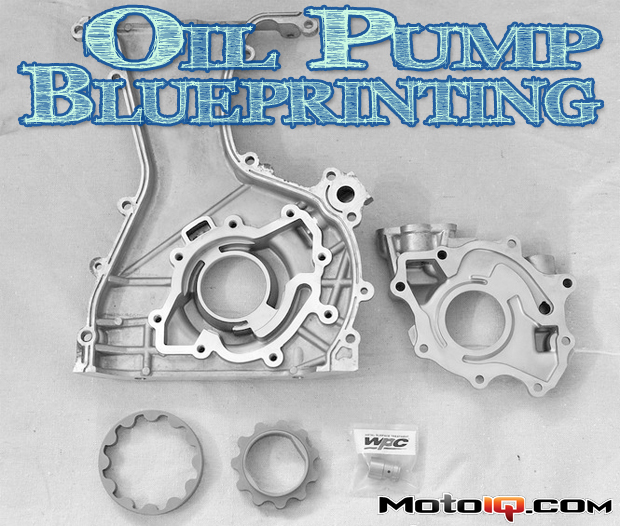
Oil Pump Blueprinting
By Martin Gonzales and Mike Kojima
What is as important to your engine's health as your heart is to your own body? If you guessed the oil pump then you are absolutely correct! Like your heart, your oil pump circulates the engine's life blood, oil, around to critical components like your engine's bearings and valvetrain. These parts, like parts of your own body, would only last seconds without a continual supply of pressurized oil.
Many people don't take care of their heart; they eat fatty foods, smoke and don't exercise. A lot of the time, this results in a heart attack and an early demise. Likewise the oil pump is a part that most people don't regard in an engine build. If it fails it can just about be guaranteed that your engine will suffer serious damage in one form or another.
 |
| Bearings are made of super soft metal to ensure that they have good embedabilty. The soft metal absorbs particles of dirt so they have less chance of damaging the crank's harder journals. The soft bearings are less likely to damage the hard crank journals if they happen to touch as well due to oil film failure. Here is a dirt contaminated bearing. Because the metal is so soft, oil pressure must always be maintained under operation and if oil pressure is lost, the soft bearing will be chewed up by the crank in a matter of seconds. |
An engine's main and rod bearings are made of a soft material. This is to ensure embedabilty, the bearing's ability to suck up dirt and debris so it won't damage the crank journals. In the old days, bearings were made of lead. Now they are made of zinc/tin alloys with copper, antimony and indium added for some additional strength and hardness. So you can imagine how easy it is to damage the bearing. In fact you can dig your fingernail in to many bearings.
 |
| If oil pressure is lost, the soft bearing material gets chewed up rapidly, then the steel shell microwelds itself to the crank, sticks and spins. This usually results in total destruction of the engine. |
 |
| Once the soft metal is breached, the crank journals will begin to score. Light scoring can be machined out by grinding the crank undersized and using an oversized bearing. Much more than this and the crank is thrashed. |
Bearings depend on a hydrodynamic pressurized film of oil between the bearing surface and the crank journal to work; if this goes away the rapidly spinning crank journal makes quick work of the soft metal bearing. The bearing will usually be damaged in seconds under load if the engine loses oil pressure.
 |
| A Hydrodynamic film is created by a Spinning journal within a bearing fed with pressurized oil. There is no metal to metal contact while the oil pump is operational. |
Not many people consider the oil pump in a build, perhaps because it's not a sexy power increasing part or perhaps because it's not talked about much. It is however perhaps the most critical part for an engine. It is also a highly stressed part which can be prone to failure. Most engines uses what is called a Gerotor pump. A Gerotor is a positive displacement pumping unit. The name gerotor is derived from "Generated Rotor". A gerotor unit consists of an inner and outer rotor spinning inside a sealed housing. The outer rotor generally has one more tooth than the inner rotor. The inner rotor is located off-center inside the outer rotor and both rotors rotate. During part of this assembly's rotation cycle, the area between the inner and outer rotor increases, creating a vacuum. This vacuum creates suction, and hence, this part of the cycle is where the intake port is located in the housing. Then, the area between the rotors decreases, causing compression. The exhaust or exit port is located over this area in the housing. Gerotor pumps are generally designed using a trochoidal inner rotor and an outer rotor formed by a circle with intersecting circular arcs.
 |
 |
| Gerotor pump showing inlet and outlet flow |
A Gerotor pump has one less tooth on the inner gear than the outer gear has. |
Thursday, June 17, 2010 5:05 AM
Out of sheer curiosity, in what situation(s) exactly would one intentionally impart loose bearing clearances? Also, first comment on the list, I guess
Thursday, June 17, 2010 9:22 AM
Interesting, I'm having oil pump and gear drive problems at the moment, so this was timely. How much was the WPC treatment? Can you break it down by component? There are some picture problems in the article, I'm getting several red Xs on the first page.
Thursday, June 17, 2010 1:56 PM
Cool article, I like how it explains the inner workings of an oil pump and then goes on to give pointers on how to rebuild one. So... stupid newbie question. On a stock or a non-rebuilt engine, how much maintenance does the oil pump require? Is there a way to determine the health of an oil pump? I'm guessing it requires an oil pressure gauge and some driving around to ensure the pressure stays consistent?
Thursday, June 17, 2010 2:27 PM
Scott- Personally I don't use loose clearances in my motors but I know some builders that do in racing classes the limit modifications to reduce all friction. I prefer to control my tolerances for straightness of the crank, etc and use middle of factory clearances. I think loose clearances cause too much windage. Bob- Please look at WPC's website and give Izumi a call. I have no idea what he charges. Speedball3- Oil pumps don't normally require maintenance and the article tells you what to look for to determine the health of the pump. Oil pressure is usually determining bearing condition.
Thursday, June 17, 2010 4:15 PM
Mike - That's good to know. How loose do you figure is too loose though? For example, Cosworth's bearings are supposedly made with an extra 0.001" of clearance, which I suspect may be for those running an extra process on their crank, such as WPC treatment (Which I understand takes up less than 0.001" of depth, but I take it having an extra 0.0005" or so of clearance isn't necessarily a bad thing?), but I'm almost certain there are people running stock cranks with such bearings. Would that be considered detrimental to bearing life? I'm not asking because I intend to use such bearings with a bone stock crank, but rather out of sheer curiosity.
Thursday, June 17, 2010 6:15 PM
Thanks for the detailed breakdown... I finally "understand" how those gears produce oil psi now...
Thursday, June 17, 2010 8:33 PM
Super generally .003 for rods and crank is pretty loose for aluminum blocks. WPC doesn't affect clearance at all.
Saturday, June 19, 2010 7:40 AM
Hi Mike, thanks for the great article! (as usual), my question for you is about the nissan/datsun fj20 engine's oil pump... It has straight cut teeth, and the timing cover has no valve for the oil pump, so what are the advantages or disadvantages of straight cut teeth over the other designs like the sr one?
Saturday, June 19, 2010 10:29 AM
I am not familiar with that pump so I don't know.

Saturday, July 17, 2010 2:24 AM
Mike I'm glad you've made an article about this. Currently I am the only individual (company) that offers a modified stock oil pump for the VG30s. I've been preaching for years on the importance of oil circulation and flow and how vital it is to the import engines, especially when many of us are building the engines to make 3-4-5 times the amount of power than it made from the factory. My belief and ethics regarding engine machining/building is not only to make power and do it consistently and evenly, but to ensure we focus our efforts on fixing the most critical issues, and the number one issue for any engine is oil supply/feed. the pump is the most crucial element in the entire assembly and I see so many turn their nose up at the modified oil pumps I offer for the VG30. Good thing the ones that do purchase and invest into these pumps get a much better approach on oil recovery, oil flow, etc etc. The other issue builders/tech guys like yourself should look at is the oiling system in the block and crankshafts. While the pump supplies the delivery of the oil is a major hurdle hardly ANYONE dives into. .
Friday, September 17, 2010 11:37 AM
Great article and am going to consider WPC treatment on my next builds. Very true Tech@EPR. I see ppl over look the oil pump all the time. I've lost an oil pump before on a higher mileage turbo KA24DE. Luckily I wasn't driving hard and managed to get home with very low oil pressure. Prolonged high engine speeds will kill an oil pump like in drifting where some bang on the rev limiter like its nothing.
Sunday, October 17, 2010 2:51 PM
I have sr20det what are some other ways to improve oil flow in my engine im going to be drifting my s13 240sx hatch and i killed one engine so far due to oiling probles and do you have any sugtion on what oil pan i should use ???
Sunday, October 17, 2010 10:46 PM
I would run a baffled pan like a greddy plus an accsump we run accusumps on all of our time attack and drift cars. On an SR, I would also groove the main bearing saddles and run the 54B style GTI-R bearings for improved rod bearing oiling. You can look at some of our SR20 engine builds here, we do it on all of them.
Tuesday, October 19, 2010 4:25 AM
Is that th RNN14 chasis thanx for the input mike any mor engine tips you have you a can email me directly at abunai_s13@yahoo.com
 
|
|
MotoIQ Proudly Presents Our Partners:
|